


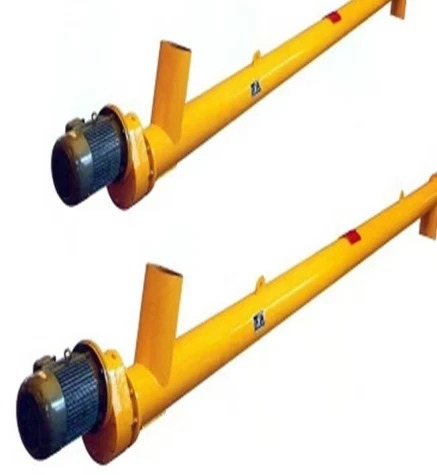
Screw Conveyor
Spiral conveyor for aerated block equipment
Working principle: gravity sliding method. The rotational speed of the spiral is relatively low, and the material on the spiral surface is more affected by gravity than centrifugal force. Due to the continuous sliding of the rotating material along the spiral surface, axial displacement is generated, and the CX spiral machine basically belongs to this principle. The principle of sliding down method, although the value of 20 is small and the conveying capacity is low, the material is in a state of easy scattering and free rolling, and is less subjected to compression. It is suitable for materials that are prone to clumping and have high abrasiveness. When using a standard spiral, not only can it maintain a fast sliding speed, but it also has a certain adaptability to inclined conveying. Don't underestimate the role of the equipment in the gas filling block equipment. Without it, the entire production line cannot operate normally.

Function: Connect raw material tanks (cement, lime, gypsum) and weighing containers.
Features: The aerated block screw conveyor is a new type of conveying equipment that uses a rotating screw body to continuously transport aerated concrete raw materials inside a closed circular cross-section shell. This machine has the characteristics of compact structure, small cross-sectional area, light weight, good sealing performance, high conveying efficiency, and flexible process layout. At the same time, a high-performance universal joint feeding port is adopted to make it more conducive to installation, production, and moisture prevention. This machine is suitable for conveying various powdery, granular, and small block materials, such as cement, clay powder, coal powder, sand, grains, small pebbles, etc.
Main technical parameters
1. Model size: Ø 200-400 L=2000-10000
2. Power: 4-11KW
Common faults and troubleshooting methods
The core faults of the screw conveyor are concentrated in areas such as poor conveying, abnormal noise and vibration, material leakage, and motor abnormalities. The following are specific faults, causes, and corresponding troubleshooting methods:
1. Insufficient conveying capacity or material blockage
Common reasons:
1 The feeding speed is too fast, exceeding the carrying capacity of the conveyor;
2. The spiral blades are severely worn and the pushing force decreases;
3. There are foreign objects blocking the discharge port or intermediate bearing;
4. The material has excessive humidity and viscosity, causing clumping and bridging.
Exclusion method:
1. Adjust the feeding speed to match the rated conveying capacity of the conveyor;
2. Replace the worn spiral blades, and if the wear is light, repair them by welding;
3. Stop the machine and clean the foreign objects at the discharge port and bearing, check and clear the blocked parts;
4. Dry the materials or install crushing and stirring devices at the feed inlet to break up clumped materials.
There is abnormal noise or severe vibration during operation
-Common reasons:
1 The spiral shaft is not concentric with the motor shaft, resulting in excessive installation deviation;
2. Bearing wear, damage, or insufficient lubrication;
3. The spiral blades deform and loosen, causing friction with the inner wall of the casing;
4. Metal and other hard impurities enter the machine.
-Exclusion method:
1 Adjust the coaxiality of the motor and screw shaft again to ensure that the deviation is within the allowable range;
2. Replace damaged bearings and regularly add suitable lubricants (such as lithium based grease);
3. Correct or replace deformed spiral blades, tighten loose connection parts, and adjust the gap between the blades and the casing;
4. Shutdown for inspection, remove hard impurities from the machine, and install a filter screen at the feed inlet if necessary.
Material leakage
Common reasons:
1 The sealing gasket at the flange connection of the casing is aged, damaged, or not tightly compressed;
2. Failure of bearing seals (such as oil seals);
3. The gap between the spiral shaft and the end of the casing is too large.
Exclusion method:
1. Replace the aging gasket, re tighten the flange connection bolts, and ensure that the sealing surface fits tightly;
2. Replace the failed bearing seals, check if the sealing grooves are intact, and repair them if necessary;
3. Adjust the position of the spiral shaft, or install sealing baffles, packing seals, and other devices at the end to reduce the gap.
Motor overheating or tripping
-Common reasons:
1. Overloaded, the conveyor operates at overload for a long time;
2. Motor bearings are damaged or poorly lubricated;
3. The motor winding is damp, short circuited or grounded;
4. Unstable power supply voltage or phase loss.
-Exclusion method:
1. Reduce the feed rate, lighten the load, and ensure that the conveyor operates within the rated power range;
2. Replace damaged motor bearings and add sufficient lubricant;
3. Conduct insulation testing on motor windings, dry damp windings, repair or replace short circuited or grounded windings;
4. Check the power supply voltage to ensure it is stable within the rated range, troubleshoot circuit faults, and solve phase loss problems.
Hot Tags: screw conveyor, China screw conveyor manufacturers, suppliers, factory
You Might Also Like
Send Inquiry