


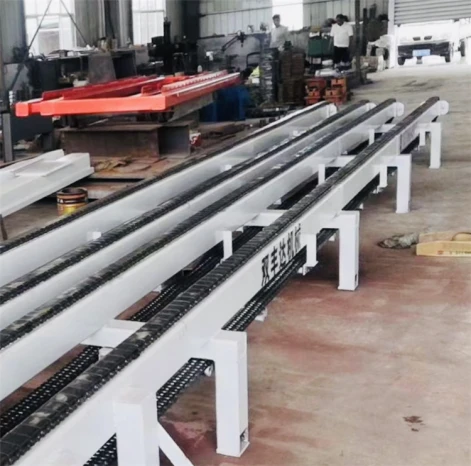
Double-jointed Flatbed Chain Conveyor Line
The double spliced flat chain conveyor line for the packaging part of aerated concrete blocks is a key conveying equipment that connects the block unloading and packaging processes. It is mainly used to smoothly and efficiently transport the blocks after unloading to the packaging station. Its core characteristics and composition can be explained from the following aspects:
Core functions
Connection process
Take over the blocks after being discharged from the kettle and transport them in an orderly manner to the rotating fixture, achieving automated flow from discharge to packaging and reducing manual handling.
Stable transportation
In response to the lightweight but vulnerable characteristics of aerated concrete blocks, a double chain and flat plate structure are used to ensure that the blocks do not shake or tilt during transportation, avoiding damage.
Structural composition (key components)
Double panel chain
Composed of four parallel plate chains, the chains are equipped with flat plates (usually made of metal material, and the surface of the plates may be treated for shock resistance). The flat plates serve as the load-bearing surface of the blocks, and the double splicing design can disperse the load, improve transportation stability, and adapt to blocks of different sizes.
01
Drive system
It is generally composed of motors, reducers, sprockets, etc., providing power for the operation of the chain. It can be adjusted through frequency conversion speed regulation to adjust the conveying speed according to the speed of the block out of the kettle and the rhythm of the packaging process, achieving linkage with the front and rear equipment.
02
Rack and guide device
Rack support chain and drive system ensure overall structural rigidity; There are guide plates or blocking wheels on both sides to prevent the chain from shifting during the conveying process, ensuring that the blocks accurately enter the rotating fixture station.
03
Tensioning device
Used to adjust the tightness of the chain, avoiding chain looseness that may cause conveyor jamming or deviation, ensuring smooth operation.
04
Main features
-Strong adaptability: The double splicing structure can flexibly adapt to different specifications of aerated concrete blocks (such as lengths of 4.0/4.2/4.8/6 meters), without the need for frequent replacement of conveying components.
-Automation compatibility: It can be linked with the control system of the kettle equipment and packaging machine to achieve continuous automation operations of "kettle outlet conveyor packaging", improving production efficiency.
-Low damage design: The flat bearing surface is flat, the chain runs smoothly, reduces friction and collision between the blocks and the conveying equipment, and lowers the rate of block damage.
-Easy to maintain: Components such as chains and plates are easy to disassemble and replace, and daily maintenance (such as lubrication and cleaning) is simple to operate, suitable for high-frequency operation scenarios in the workshop.
Application scenarios
Mainly used for the pre packaging stage of aerated concrete blocks after discharge from the kettle, especially suitable for palletized packaging of blocks in large-scale production. It can be used in conjunction with automated packaging machines (such as fully automatic winding machines and strapping machines) to achieve efficient circulation and is an important intermediate transportation equipment for blocks from production to finished product packaging.
Main technical parameters
1. Model size: 10m/12m/14m, etc. can be customized as needed
2. Mass: 2400 kilograms
3. Power: 6Kw
4. Operating speed: 5-15m/min, variable frequency adj
Common faults and their solutions
The core faults of the double splicing flat chain conveyor line are concentrated in the chain, drive system, flat plate, and tensioning device. The handling should follow the principle of "stopping the machine for inspection first, then locating the cause, and finally targeted repair".
1. Chain related faults
-Chain jamming/sticking: First, stop the machine and cut off the power. Check if there are any foreign objects (such as material residue or metal blocks) at the meshing point between the chain and sprocket. After cleaning, check if the chain joints are corroded or severely worn, and add lubricating oil (such as gear oil) for lubrication; If the wear of the sprocket teeth is uneven, the corresponding sprocket needs to be replaced.
-Chain deviation: Observe whether the tightness of the chains on both sides is consistent. If one side is too loose, adjust the tensioning device on that side (tighten the tensioning screw); Check if the sprockets are coaxial. If they are offset, loosen the fixing bolts of the motor or reducer, adjust them to align the center lines of the sprockets on both sides, and then re fix them.
-Chain breakage: Immediately stop the machine and replace the spare chain (pay attention to matching the chain model when replacing); If there are obvious signs of wear or fatigue at the fracture site, it is necessary to check for overload operation (such as conveying materials that are overweight), and subsequently control the conveying volume.
2. Drive system malfunction
-Motor abnormal noise/non rotation: After power off, check whether the motor wiring is loose or poorly connected, unplug and tighten the wiring terminals again; If the motor makes a buzzing sound but does not rotate, it may be due to bearing damage or rotor blockage, and the motor needs to be disassembled to replace bearings or clean internal foreign objects; If the motor burns out, it needs to be replaced with a motor of the same power.
-Oil leakage/abnormal noise of reducer: Check whether the sealing components (such as oil seals) of the reducer are aging, replace the sealing components and replenish the gear oil; If there is a metal friction sound inside the reducer, it may be due to gear wear or bearing damage, and the worn parts need to be disassembled and replaced.
3. Tablet and connector malfunction
-Loose/misaligned flat plate: After stopping the machine, check the connection between the flat plate and the chain (such as bolts and buckles), tighten loose bolts or replace damaged buckles; If the positioning hole of the tablet becomes larger due to long-term wear, a new tablet needs to be replaced.
-Flat plate fracture/deformation: Replace the broken or severely deformed flat plate, and check whether there are sharp edges or instantaneous impact forces in the conveyed material. If necessary, install protective pads on the surface of the flat plate or adjust the feeding method.
4. Tensioning device malfunction
-Insufficient tension: Loose chains can easily cause tooth skipping. It is necessary to tighten the adjusting screw of the tensioning device clockwise until the chain sag is controlled at 5-10mm (manually lift the middle of the chain), and then lock the nut in place.
-Tightening device stuck: Clean the dust and oil stains on the tensioning slider or guide rail, apply lubricating grease (such as lithium based grease), and ensure that the tensioning device can move flexibly; If the slider is severely worn, it is necessary to replace the slider or guide rail.
Common faults and their solutions
The core faults of the double splicing flat chain conveyor line are concentrated in the chain, drive system, flat plate, and tensioning device. The handling should follow the principle of "stopping the machine for inspection first, then locating the cause, and finally targeted repair".
-Chain jamming/sticking: First, stop the machine and cut off the power. Check if there are any foreign objects (such as material residue or metal blocks) at the meshing point between the chain and sprocket. After cleaning, check if the chain joints are corroded or severely worn, and add lubricating oil (such as gear oil) for lubrication; If the wear of the sprocket teeth is uneven, the corresponding sprocket needs to be replaced.
-Chain deviation: Observe whether the tightness of the chains on both sides is consistent. If one side is too loose, adjust the tensioning device on that side (tighten the tensioning screw); Check if the sprockets are coaxial. If they are offset, loosen the fixing bolts of the motor or reducer, adjust them to align the center lines of the sprockets on both sides, and then re fix them.
-Chain breakage: Immediately stop the machine and replace the spare chain (pay attention to matching the chain model when replacing); If there are obvious signs of wear or fatigue at the fracture site, it is necessary to check for overload operation (such as conveying materials that are overweight), and subsequently control the conveying volume.
-Motor abnormal noise/non rotation: After power off, check whether the motor wiring is loose or poorly connected, unplug and tighten the wiring terminals again; If the motor makes a buzzing sound but does not rotate, it may be due to bearing damage or rotor blockage, and the motor needs to be disassembled to replace bearings or clean internal foreign objects; If the motor burns out, it needs to be replaced with a motor of the same power.
-Oil leakage/abnormal noise of reducer: Check whether the sealing components (such as oil seals) of the reducer are aging, replace the sealing components and replenish the gear oil; If there is a metal friction sound inside the reducer, it may be due to gear wear or bearing damage, and the worn parts need to be disassembled and replaced.
-Loose/misaligned flat plate: After stopping the machine, check the connection between the flat plate and the chain (such as bolts and buckles), tighten loose bolts or replace damaged buckles; If the positioning hole of the tablet becomes larger due to long-term wear, a new tablet needs to be replaced.
-Flat plate fracture/deformation: Replace the broken or severely deformed flat plate, and check whether there are sharp edges or instantaneous impact forces in the conveyed material. If necessary, install protective pads on the surface of the flat plate or adjust the feeding method.
-Insufficient tension: Loose chains can easily cause tooth skipping. It is necessary to tighten the adjusting screw of the tensioning device clockwise until the chain sag is controlled at 5-10mm (manually lift the middle of the chain), and then lock the nut in place.
-Tightening device stuck: Clean the dust and oil stains on the tensioning slider or guide rail, apply lubricating grease (such as lithium based grease), and ensure that the tensioning device can move flexibly; If the slider is severely worn, it is necessary to replace the slider or guide rail.
Hot Tags: double-jointed flatbed chain conveyor line, China double-jointed flatbed chain conveyor line manufacturers, suppliers, factory
You Might Also Like
Send Inquiry