


Mobile Mold Clamping Car
The mobile mold merging and molding trolley for aerated concrete blocks is a commonly used transportation vehicle in the process of packaging aerated concrete blocks. Here is the relevant introduction:
-Function: Responsible for transporting the aerated block blank from the steam curing cart to the mobile mold merging and embryo merging cart using single-mode or dual-mode fixtures. The mobile mold merging and embryo merging cart then transports the merged two mold products to the rotating fixture for the next process.
Structural composition
Frame
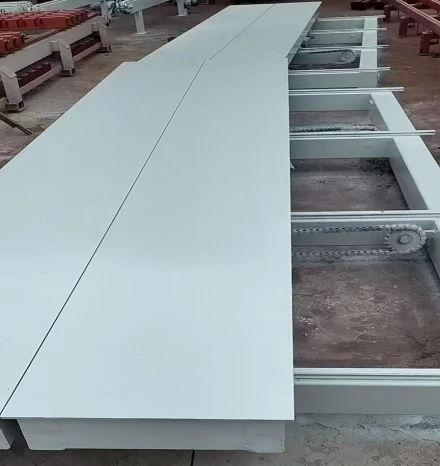
The main structure is usually composed of steel sections, which have good rigidity and stability. The upper part of the frame is equipped with a bottom plate guide device for easy placement of the bottom plate.
Wheel components
including wheels, shafts, and bearings. The surface of the wheel has undergone quenching treatment, making it durable and long-lasting. Its internal structure is specially designed to ensure that the bearings can still roll sensitively and operate reliably in high temperature and high pressure environments of the autoclave.
Auxiliary devices, such as guide wheels and limit devices, are used to ensure the smooth operation of the trolley on the track and prevent derailment or collision.
Return and cycle
After completing one round of work, the car returns to the single-mode or dual-mode fixture to prepare for the next round of work cycle. Generally, the two cars alternate and cycle to achieve higher efficiency.
Mobile mold merging and embryo car
The mobile mold merging and molding trolley for aerated concrete blocks is a commonly used transportation vehicle in the process of packaging aerated concrete blocks. Here is the relevant introduction:
-Function: Responsible for transporting the aerated block blank from the steam curing cart to the mobile mold merging and embryo merging cart using single-mode or dual-mode fixtures. The mobile mold merging and embryo merging cart then transports the merged two mold products to the rotating fixture for the next process.
Structural composition
Frame
The main structure is usually composed of steel sections, which have good rigidity and stability. The upper part of the frame is equipped with a bottom plate guide device for easy placement of the bottom plate.
Wheel components
ncluding wheels, shafts, and bearings. The surface of the wheel has undergone quenching treatment, making it durable and long-lasting. Its internal structure is specially designed to ensure that the bearings can still roll sensitively and operate reliably in high temperature and high pressure environments of the autoclave.
Auxiliary devices, such as guide wheels and limit devices, are used to ensure the smooth operation of the trolley on the track and prevent derailment or collision.
Return and cycle
After completing one round of work, the car returns to the single-mode or dual-mode fixture to prepare for the next round of work cycle. Generally, the two cars alternate and cycle to achieve higher efficiency.
Common faults and their solutions
Mechanical faults
1. Clamping or inability to complete the mold closing action
-Reason for malfunction: Wear and insufficient lubrication of the guide rail or slider; Aging and leakage of the sealing components of the clamping oil cylinder; Mechanical limit block position offset.
-Solution: Check the wear of the guide rail/slider, replace severe components, and add special lubricating oil; Replace the oil cylinder seal and replenish hydraulic oil; Adjust the limit block to the standard position and tighten the fixing bolts.
2. Unstable movement or abnormal noise of the embryo car
-Reason for malfunction: Worn or loose moving wheels; Loose and worn transmission chain/belt; There are foreign objects or deformations on the track.
-Solution: Replace worn wheels and tighten loose parts; Adjust the tension of the chain/belt and replace worn parts; Clean up foreign objects on the track and straighten the deformed track.
Hydraulic/pneumatic faults
Insufficient hydraulic system pressure
-Reason for malfunction: hydraulic pump damage or wear; Overflow valve malfunction; Insufficient hydraulic oil, contamination, or viscosity mismatch.
-Solution: Repair or replace the hydraulic pump; Clean and calibrate the overflow valve, and replace it if necessary; Supplement and replace hydraulic oil that meets specifications, clean the oil tank and filter screen.
Pneumatic components leak air
-Reason for malfunction: Loose or aged tracheal joint; The cylinder seal is damaged; The solenoid valve core is worn.
-Solution: Re tighten or replace the tracheal joint; Replace the cylinder seal; Clean or replace the solenoid valve.
Electrical faults
1. The control button is unresponsive
-Reason for malfunction: button contact oxidation or damage; Poor or broken contact of the circuit; Power failure.
-Solution: Polish the contact points or replace the button; Check the circuit and reconnect/replace the wires; Check the power switch and fuse to restore normal power supply.
2. Sensor false alarm or failure
-Reason for malfunction: Sensor position offset; Surface covered with dust and oil stains; The sensor itself is faulty or the circuit is faulty.
-Solution: Recalibrate the sensor position; Clean the surface of the sensor; Replace the faulty sensor, check and repair the circuit.
Hot Tags: mobile mold clamping car, China mobile mold clamping car manufacturers, suppliers, factory
You Might Also Like
Send Inquiry